



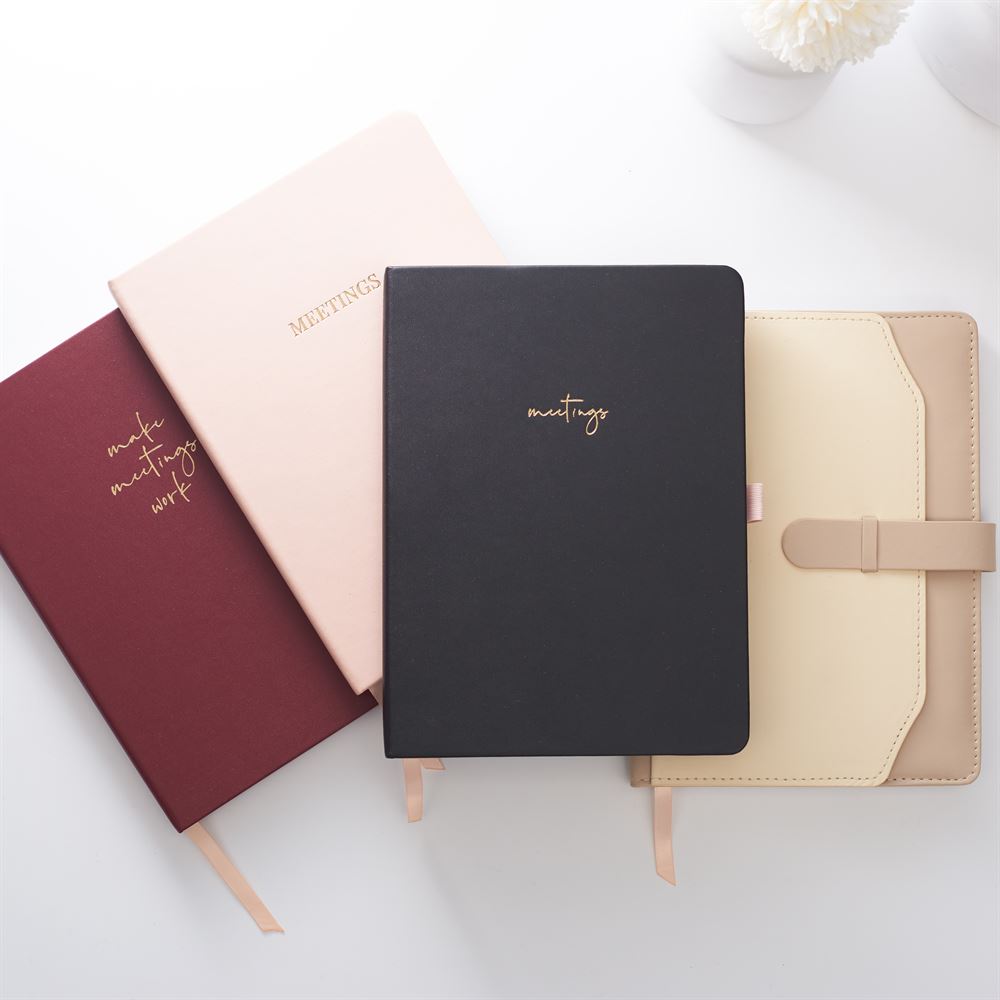

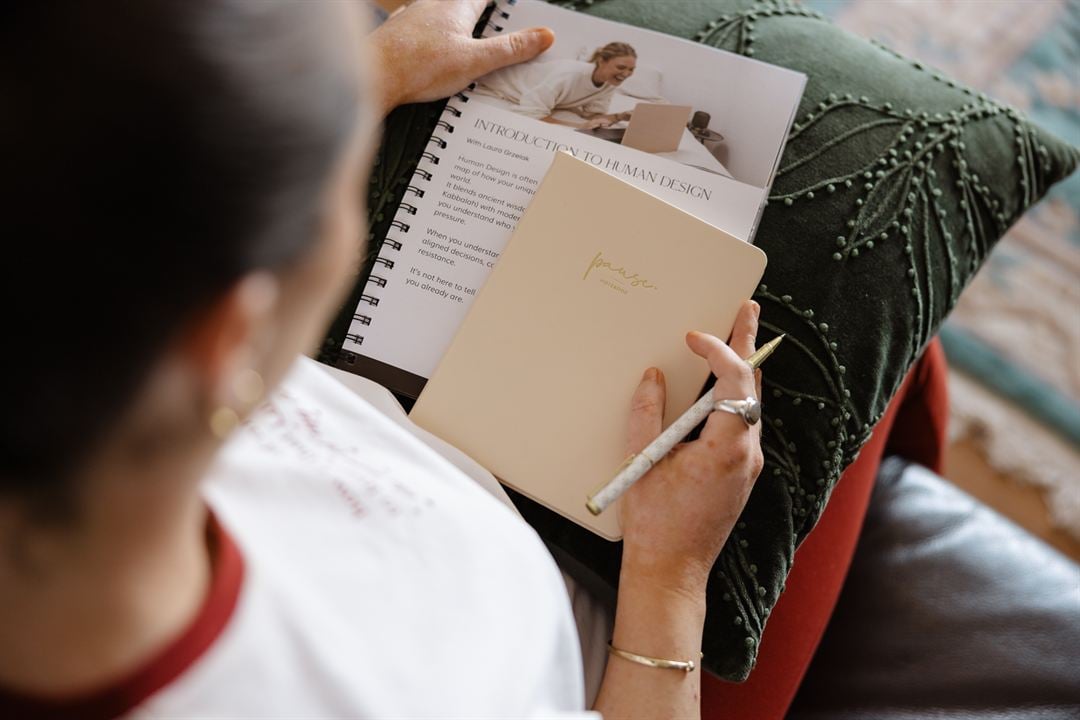
This year, I was sitting in a room of 400 women at a Gen Collective International Women’s Day event, watching Cathy Freeman speak. Yes, THE Cathy Freeman, star of the Sydney 2000 Olympics, and one of the most groundbreaking women in Australian sporting history. I was already moved just being in the room.
Then Cathy took the microphone and said: “Where is Kasia from LH Agenda?” I could not believe it. My friend barely caught a snap for the ‘gram, and I seriously wish I had filmed it because my brain completely glitched. Cathy went on to share how much she loved the Meet Yourself Journal I created, and spoke about the power of journalling for self-awareness and mental health. Hearing someone like Cathy talk about reflection, awareness and the discipline of understanding yourself from the inside out felt deeply grounding.
Because journalling is not really about writing. It is about pausing long enough to notice what is going on inside your own mind. The best athletes in the world train their bodies with extraordinary intention. But the greatest ones also train their mental clarity, focus and self-awareness. That realisation is what inspired us to create the Meet Yourself Journal. Not productivity. Not perfection. Just a space to slow down and meet yourself.
This guide will show you the science behind why journalling works, how to build a practice that sticks, and what to write when you do not know where to start. You may already have a journalling habit, or perhaps the blank page has always felt more paralysing than freeing. Either way, there is something here for you.
Table of contents
- Why “thinking it through” is not working
- What journalling actually does to your brain
- Why journalling is more than emotional release
- How to start journalling
- How to start journalling when you do not know what to write
- 12 journalling prompts to meet yourself on the page
- Different types of journalling
- Why reviewing your journal regularly is essential to your growth
- Your journalling checklist
- Your journalling practice in action
Why “thinking it through” is not working
Most of us are dealing with our inner world the wrong way. And it is not our fault.
When something difficult happens, we do what feels natural: we think about it. We turn it over on the drive home, replay it in the shower, lie awake rehearsing conversations that already happened or ones we are dreading. We call this processing. But what is actually happening is looping: cycling the same unresolved thought or feeling without ever reaching resolution.
Early twentieth-century psychologist Bluma Zeigarnik discovered that the brain holds unfinished things active in working memory. Unresolved tasks, incomplete conversations, unexpressed emotions: they sit in the brain’s active RAM (short for Random Access Memory, the part of your mind that keeps things running in the background, consuming energy even when you are not actively thinking about them) fuelling background anxiety and making it harder to focus on anything else. This is the Zeigarnik Effect. If you have ever been unable to enjoy a Sunday because something from Friday is still nagging at you, you have felt it.
The brain does not want to store unfinished business. It wants to resolve it. And one of the most effective ways to signal that resolution, to tell your nervous system that a loop can close, is to write it down. Think of the journal as an external hard drive. Your brain is the processor: fast, creative, brilliant at making connections. But it was never designed to be the storage unit too. When you offload your thoughts and feelings onto the page, you free up mental space to actually think clearly.
What journalling actually does to your brain
In 1986, Dr. James Pennebaker ran a series of studies that changed how researchers understood the relationship between writing and wellbeing. Participants who wrote about their deepest thoughts and feelings around difficult experiences for just fifteen to twenty minutes a day showed measurable improvements in physical health, reduced anxiety, and greater psychological wellbeing. They also visited health centres significantly less in the months that followed.
Pennebaker’s insight was not that writing makes difficult things disappear. It was that translating raw emotional experience into language changes how the brain organises it, moving it from the reactive limbic system toward the meaning-making prefrontal cortex. You shift from something happening to you, to someone making sense of it. That shift is where healing starts.
Dr. Brene Brown’s research puts it plainly: we cannot ignore our difficult stories without them eventually owning us. Naming the pain, writing it down, is the starting point for healing. It is how we begin to own our narratives, rather than be owned by them.
“The page is not just a place to record your life. It is a place to understand it.”
The Meet Yourself Journal was built around exactly this understanding. Its dot-lined pages, thoughtful prompts, and built-in guide to starting a journalling practice create the structure your brain needs to move from looping to resolving.
Ashley Wright of Strokes of Freedom shares what this looks like in practice. She uses the Meet Yourself Journal as her weekly brain dump: a dedicated meeting with herself to get everything out of her head and onto the page.
“We have thousands upon thousands of thoughts each day. This journal helps me just to get everything out of my head. So instead of carrying all these things around in my brain, I let the pages do all the work for me. The more that I use my Meet Yourself Journal to explore my own ideas and thoughts and feelings, the more I discover about myself as a person.” — Ashley Wright, Strokes of Freedom
View this post on Instagram
Why journalling is more than emotional release
There is a common misconception that journalling is only useful when something is wrong: when you are grieving, anxious, or overwhelmed. In reality, a consistent journalling practice is one of the most powerful tools for building the kind of self-awareness that changes how you move through every area of your life.
Journalling allows you to be honest and write all that you feel without judgement, to witness your emotions, behaviours and patterns, and begin to process them. By allowing yourself the safety of the page, you can first declutter emotionally, but then gain perspective on your thoughts and stresses to understand how best to move through them.
A journalling habit can also help you tap into your intuition. It gives you the quiet space to hear it. Often, the answers or advice we seek are already within us. We just need to feel comfortable looking inside. The turning point of journalling comes when you can observe your own writing with curiosity and self-awareness, asking how you might best support yourself, or begin to rewrite the negative beliefs that impact your wellbeing.
“This is the second order of journals and products. I’m in love. First the journals are amazing, with thoughtful prompts and quotes to inspire…” — Heather, Verified Buyer
The Mind by Design collection was created for exactly this deeper kind of inner work: journals and tools designed to build mental fitness, resilience and overall wellbeing over time, not just in moments of crisis.
How to start journalling
There is really only one rule when it comes to how to start journalling: show up and be honest. Everything else is negotiable.
Start small. Set a timer for fifteen minutes, or commit to writing one page a day. Allow your pen to do the talking. Do not worry about perfect spelling, grammar, or everything making sense. There is no need to edit as you go, just keep writing what comes up. It is completely fine to write all your emotions, even the uncomfortable ones and the ones you do not like. Give them some air time on the page to diffuse them.
Author and creativity teacher Julia Cameron offered a deceptively simple approach in her 1992 book The Artist’s Way: three longhand pages of stream-of-consciousness writing, done before the analytical mind has woken up enough to start editing and judging. She calls this practice Morning Pages. The content barely matters. What matters is the act: draining the mental clutter before the day begins, so there is room for something clearer to come through.
One important note: always leave the page feeling safe. You may write about difficult emotions or experiences, but try not to close the journal while still in that state. You might write a positive affirmation, list three things you are grateful for, write a thank you to yourself for having the strength to show up, or soothe yourself with kind words the way you would speak to a friend.
“This is one of the best journals I’ve had. I’m buying more as gifts as we speak!” — Catherine D., Verified Buyer
If a blank page feels more paralysing than freeing, the Good Morning Good Night Journal offers a structured five-minute-a-day approach with gentle prompts at either end of the day that open the faucet without requiring you to figure out where to begin.
View this post on Instagram
How to start journalling when you do not know what to write
The blank page is not a problem of motivation. It is a problem of direction. When you do not know where to start, a prompt is not a crutch: it is a door. You walk through it, and then you write wherever the thought takes you. The prompt opens the faucet. The rest flows.
Some of the most useful prompts are the simplest ones. How am I feeling right now? What is on my mind? What do I need most today? These are not small questions. Given the space and honesty to answer them properly, they have a way of opening into much larger territory.
The key is to keep the pen moving. Do not stop to assess what you have written. Do not re-read as you go. The inner critic is fast and loud when you give it the chance to interrupt. Write past it. The real writing, the honest writing, usually begins about three sentences after the part that felt too uncomfortable to say.
Use prompts as a starting point, not a constraint. If you begin with a prompt and then go entirely off-script, that is not a failure. That tangent is often where the most useful thinking lives. The Meet Yourself Journal includes a full guide to building a journalling practice with thoughtful prompts woven throughout, so the structure is there when you need it, and the space is there when you do not.
12 journalling prompts to meet yourself on the page
“Fill your paper with the breathings of your heart.” — William Wordsworth
These prompts are drawn from the Meet Yourself Journal. Use one at a time. Write for at least ten minutes without stopping. Follow any thread that pulls at you, even if it leads somewhere unexpected.
- How was my day? What did I like about it? What did I not like?
- How am I feeling right now?
- What is on my mind right now? What is this thought trying to tell me? Is this thought helping or hindering me, and what can I take from it?
- What do I need most right now?
- What do I need more of in my life? What do I need less of?
- What answers am I seeking at the moment?
- What beliefs about myself are holding me back?
- What do I feel guilty about? What do I want to forgive myself for?
- What am I scared of?
- What makes me feel healthy, enthusiastic and full of life?
- What is special in my life right now? How can I create more space for it?
- What does “love” mean to me? Tip: replace “love” with any feeling you want to explore more deeply: joy, safety, freedom, ambition. The same question becomes a different conversation every time.
A note on closing: after working through a prompt that brings up difficult emotions, take a moment before you close the journal. Write down one thing you are grateful for. Acknowledge yourself for showing up. Leave the page in a better state than the one you arrived in — a kind word, a small thing you are looking forward to, or simply a breath of relief that you gave yourself the space.
You can download these prompts and print them out from here.
Different types of journalling for personal growth and wellbeing
Not all journalling looks the same, and it does not have to. The practice shapes itself around what you need: clarity on a decision, a space to process a difficult week, a structured prompt to move through a creative block, or simply a few minutes of quiet before the day begins. What matters is that you find the format that keeps you coming back.
The LH Agenda Mind by Design and Make Your Mark Collections supports reflective, growth-oriented practice across multiple formats, from structured journals to everyday tools such as notebooks and planners designed specifically for personal growth and building mental resilience over time.
1. Journalling for clarity and problem solving
This is probably the most common reason people start journalling, even if they do not realise it at first. Something feels stuck. A decision needs to be made. Too many thoughts are competing for space and none of them are winning. The journal is where you go to sort it out.
Motivational speaker and bestselling author Mel Robbins has talked about this for years. Her method is simple: take a blank page and do a brain dump. Write down everything that is in your head — your to-dos, your worries, the conversations you are avoiding, the decisions you are putting off. Do not organise it. Do not edit it. Just get it out. Your brain is a processor, not a storage unit. When it is trying to hold everything at once, it shuts down. The page is what sets it free.
From there, clarity tends to follow naturally. Once your thoughts are visible, you can start to work with them: make an organised to-do list from the chaos, map out a pros and cons list for a decision you have been avoiding, or simply notice which worries dissolve the moment you write them down and which ones still feel real and worth addressing.
The Worry Be Gone Clarity Journal was designed precisely for this kind of thinking. It takes you through the process of externalising your concerns, examining them honestly, and finding a clearer path forward. If your mind tends toward anxiety or overthinking, having a dedicated space to work through worries — rather than just spin in them — changes the experience entirely.
2. Journalling for career progression
Leadership is not a title. It is a way of showing up: for your team, your clients, the people in your life, and yourself. And the clarity required to lead well does not come from busyness. It comes from reflection.
Many of the clearest thinkers and most effective leaders maintain some form of regular journalling practice, not because they have more time than anyone else, but because they have learned that the ten minutes they spend writing saves them hours of reactive decision-making. When you process your thinking on the page, you arrive at conversations and decisions with more clarity, less noise, and better questions.
If you want to use journalling for deliberate career direction, the Aspire Career Designer walks you through a structured reflection process to map the work that would genuinely fulfil you and build a realistic path toward it. Many people spend years in the wrong career simply because they have never sat down and asked themselves, on paper, what they actually want.
Useful starting prompts for career journalling:
- What kind of leader do I want to be, and how does that compare to how I showed up this week?
- What decision am I avoiding, and why?
- What would I do in my career if I already knew I could not fail?
- What do I need to stop doing so that the important work has room to breathe?
3. Journalling for self-leadership
Leadership requires a particular kind of self-knowledge: the ability to see yourself clearly, to understand how you affect the people around you, and to keep growing even when things are going well. That kind of awareness does not develop in meetings or performance reviews. It develops in the quiet, honest work of reflection.
Journalling gives leaders a private space to ask the questions they rarely get to ask out loud. What kind of leader am I becoming? Where am I showing up with confidence, and where am I holding back? What does my team need from me right now that I have not been giving? These are not easy questions. But written down, on a page that asks nothing back, they become workable.
The Make Your Mark Journal was developed specifically for this kind of inner leadership work. It is a self-coaching journal filled with practical exercises, assignments, and inspirational prompts developed in collaboration with respected leadership experts to help you build six key leadership traits. It is used by coaches, executives, and everyday leaders who want to move from reactive to intentional, and from doing to leading with purpose.
Useful starting prompts for leadership journalling:
- What does leading with integrity look like for me right now?
- Where am I spending energy on things that are not mine to carry?
- What conversation have I been putting off, and what is it costing me?
- What would my most grounded, clear-headed self do here?
4. Journalling for self-awareness
Self-awareness is not a personality trait you either have or do not have. It is a skill, and like any skill, it develops with consistent practice. Journalling is one of the most reliable ways to build it, not because writing is magical, but because the act of putting something into words forces a level of precision that thinking alone rarely achieves.
When you write about a situation, you are not just recording it. You are interpreting it. You are making choices about what mattered, what you felt, what you wish you had done differently. Over time, those interpretations become patterns. The journal becomes a record of how you actually think, not how you assume you think, and that is an enormously useful thing to be able to read back.
“Journalling is a powerful practice to truly meet yourself and develop self-awareness. It allows you to be honest and write all that you feel without judgement, to witness your emotions, behaviours and patterns, and begin to process them.” — Meet Yourself Journal
The Meet Yourself Journal was designed for exactly this kind of inner work. With thoughtful prompts and a built-in guide to building a journalling practice, it gives you the structure to begin and the space to go wherever your thinking leads.
5. Journalling for mental wellbeing
Journalling is not a substitute for professional mental health support. But it is a powerful complement to it, and for many people, it is the practice that makes everything else easier to manage.
Dr. Pennebaker’s research showed that people who wrote expressively about difficult experiences visited health centres measurably less in the months that followed. The physical body, it turns out, responds to the mind being given space to process. Writing does not just help you feel better. Over time, it can help you be better.
A regular journalling practice also builds what psychologists call affect labelling: the ability to name your emotional state with precision. Research published by the UCLA Social Cognitive Neuroscience Laboratory found that simply labelling an emotion reduces activity in the amygdala (the brain’s alarm system) and increases activity in the prefrontal cortex. You feel less overwhelmed not because the situation has changed, but because you have language for what is happening inside you.
“Time spent caring for your mental wellbeing is never wasted. Journalling is one of the simplest ways to create that space: a quiet moment to slow down, declutter your mind, and gain perspective on your thoughts and emotions.”
The Thrive Mind Designer was built for exactly this work. It is a self-coaching journal for mental resilience that helps you prioritise your wellbeing, recover from difficulties with more ease, and move beyond coping toward genuine growth. Rather than simply recording how you feel, it guides you through the process of understanding why, and what you can do about it.
6. Journalling for intentional living and gratitude
Not every journalling session needs to be deep. Some of the most powerful shifts come from the small, consistent practice of checking in: at the start of the day before the noise sets in, and at the end of the day before you close it out. Five minutes, morning and evening, is enough to change the quality of your attention over time.
Morning journalling gives you the chance to set the tone before the world sets it for you. Evening journalling gives you the chance to close the day with awareness rather than letting it blur into the next one. A few questions to carry into each:
Morning:
- What do I want to carry into today?
- What matters most right now?
Evening:
- What went well today?
- What am I grateful for?
- What do I want to do differently tomorrow?
This kind of practice does not require a lot of time or a lot of words. It requires only that you show up, honestly, twice a day. The Good Morning Good Night Journal is structured specifically around this rhythm: a five-minute daily practice, morning and night, that builds self-awareness, gratitude, and intentionality one small entry at a time. It is the gentlest possible entry point into journalling, and for many people, the one that finally makes the habit stick.
Why reviewing your journal regularly is essential to your growth
A monthly review practice extends this further. Set aside thirty minutes at the end of each month or quarter to read back through your entries. Patterns emerge that are invisible day-to-day: recurring anxieties, evidence of growth you had not noticed, signals about what you truly value. This is where the journal becomes a map, not just a record.
Your journalling checklist
Write by hand. The physical act of handwriting engages neural pathways that typing does not, deepening the connection between thought and language. The Journal of Writing Research consistently finds that handwriting produces a stronger encoding effect than digital typing: the slower pace forces synthesis rather than transcription, and that synthesis is where real clarity lives. When the goal is reflection, the pen outperforms the keyboard.
Write as if no one will read it. This is the single most important condition for honesty. The moment you start writing for an audience, even an imagined one, you start editing, and the edit is where the truth gets lost. The journal is the one place where you do not need to be coherent, impressive, or fair. You just need to be real.
Make it a ritual. The frequency matters less than the commitment. Whether you journal every morning, every Sunday evening, or three times a week, what builds the practice is treating it as a non-negotiable: the same way you would treat a meeting with someone you respect. Because that is exactly what it is. A meeting with yourself.
Your journalling practice in action
Here is what a simple, sustainable journalling practice looks like when it is actually working.
Choose your time and protect it. Fifteen minutes is enough to start. The best time is the one you will actually keep — whether that is before the household wakes up, on your lunch break, or in the last few minutes before you turn off the light.
Choose your journal. Choose your journal based on where you are right now. If you need structure, start with prompts. If you need space, start with blank pages. Both are valid. Both work. The Good Morning Good Night Journal and the Meet Yourself Journal sit at opposite ends of that spectrum, and between them they cover most of what people need when they are starting out.
Open the journal before you open anything else. Before your phone, before your email, before the news. Give yourself the first few minutes of the day, or the last few minutes of the evening, before the world gets in.
Pick a prompt from this guide if you do not know where to start. Write for ten to fifteen minutes without stopping. Do not edit. Do not re-read until you are finished. Close with something grounding: a moment of gratitude, a kind word to yourself, one thing you are looking forward to.
The journal does not ask you to be productive. It asks you to be present. And in a world that is constantly pulling your attention outward, that is a radical and necessary act. Set your agenda. Meet yourself first
—
Ready to begin your journalling practice? Explore the Meet Yourself Journal for open-page journalling with thoughtful prompts, or the Good Morning Good Night Journal for a structured five-minute daily practice. Explore the full Mind by Design collection for tools designed to support your mental fitness and wellbeing over the long term. And if you want somewhere to begin, download the free 12 Journalling Prompts to Meet Yourself on the Page — print it out, keep it in your journal, and reach for it whenever the blank page feels like too much.

Kasia Gospoś is the founder of LH Agenda, a wellness lifestyle brand dedicated to empowering women to lead with clarity, intention, and purpose. What began as a personal journey to create more meaningful structure and balance has evolved into a global movement supporting modern women through thoughtfully designed planners, journals, and tools that nurture mental fitness, resilience, and self-leadership. At its heart, LH Agenda exists to help you move from overwhelm to alignment, and to design a life that reflects who you truly are and who you are becoming.
Join our community for exclusive resources, insights, and tools to support your journey.


Leave a Reply